
Datatel Highlights Business Outcomes Driving Phone Payment Modernization
The article, entitled “The Business Outcomes Driving Organizations to Modernize Phone Payments,” explains how many businesses are not modernizing phone payments because of a sudden interest in technology. They are doing so to improve customer experience, accelerate collections, reduce operational friction, support business continuity, lower manual dependency, and create more scalable service operations.
Toronto, Canada / Miami, FL (PRUnderground) June 16, 2026
Datatel Communications Inc (USA) / Datatel Inc (Canada), a leader in IVR Payments, today released a deep dive into how businesses are increasingly reassessing phone payment workflows as part of broader operational modernization efforts, according to their latest thought leadership article.
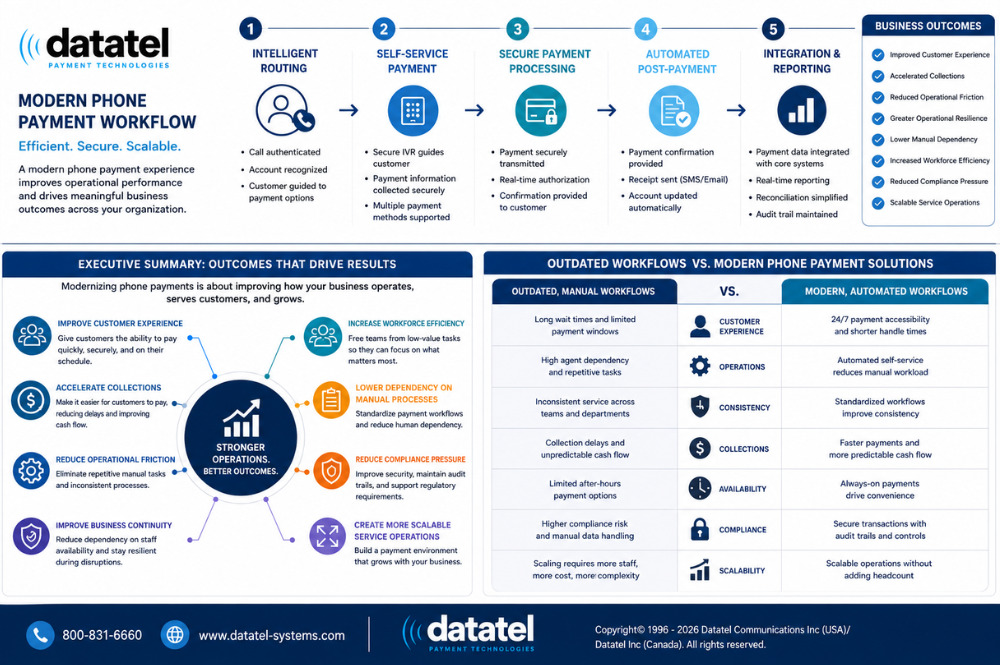
The article, entitled “The Business Outcomes Driving Organizations to Modernize Phone Payments,” explains how many businesses are not modernizing phone payments because of a sudden interest in technology. They are doing so to improve customer experience, accelerate collections, reduce operational friction, support business continuity, lower manual dependency, and create more scalable service operations.
Many organizations still rely on payment workflows where employees verbally collect payment information and manually facilitate transactions. While these processes may continue to function, they can limit operational performance as customer expectations, staffing models, compliance pressure, and service demands evolve.
“Modernizing phone payments is not simply about replacing a process,” said Datatel’s Co-CEO Barnard Crespi. “It is about improving how money moves through the organization so leaders can achieve better operational outcomes.”
The article identifies payment workflows as a critical operational intersection point where revenue collection, customer experience, compliance, workforce efficiency, and business continuity meet. When workflows depend heavily on live staff, organizations may experience longer wait times, limited payment accessibility, slower collections, higher call pressure, and inconsistent service delivery.
Modern IVR payment environments can help organizations create more structured, consistent, and accessible payment workflows. While customers gain the ability to complete payments quickly, securely, independently, and outside traditional business hours, organizations gain improved workflow consistency, reduced dependency on manual facilitation, and greater predictability across customer service and collections operations.
The article also notes that operational resilience has become a more important part of the payment modernization discussion. Staffing shortages, remote work transitions, call spikes, seasonal surges, severe weather events, business continuity incidents, and rapid growth can expose weaknesses in manual payment processes.
Datatel emphasizes that organizations modernizing successfully are those that are evaluating phone payment systems as operational infrastructure, not simply as payment tools.
Learn more: https://www.datatel-systems.com/article/phone-payment-modernization-for-better-business-outcomes/
#Datatel #PhonePayments #IVRPayments #PaymentModernization #OperationalEfficiency
Also published on
Distributed via PR Underground